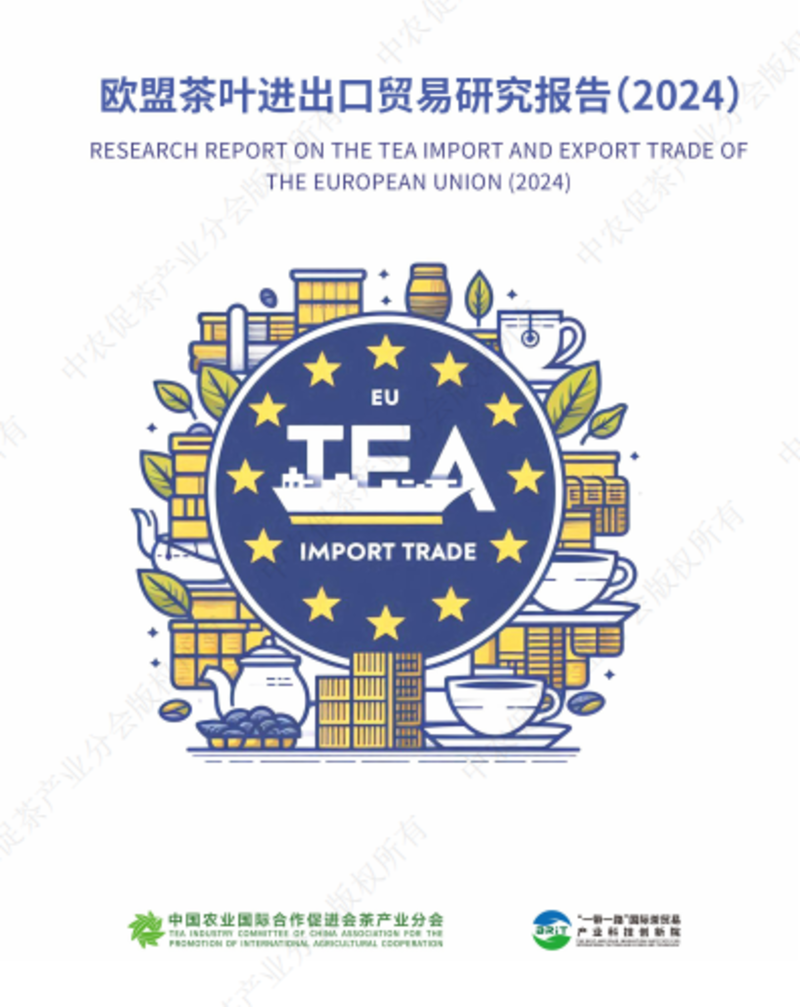
Recently, the Research Report on the Tea Import and Export Trade of the European Union (2024) (hereinafter referred to as the "Report"), compiled by the Tea Industry Committee of China Association for the Promotion of International Agricultural Cooperation and The Belt and Road Innovation Institute for International Tea Trade and Science and Technology, was officially released. The Report systematically reviews the overall situation of EU tea imports and exports from 2020 to 2024, providing data support for relevant industries and policy formulation.
The Report shows that in 2024, the EU's tea import value reached 583 million euros, a year-on-year increase of 11.45%; the import volume was 119,800 tons, a year-on-year increase of 6.61%; with an average price of 4.87 euros/kg. Among them, China became the EU's largest tea supplier with a volume of 24,400 tons, accounting for 20.37% of the total import volume.The import value was 99.5246 million euros, ranking second among EU tea suppliers, with an average price of 4.08 euros/kg, which is relatively low among major trading partners.
In addition to macro data, the Report also provides an in-depth analysis from three key dimensions: tea category structure, member state markets, and trade patterns.
Regarding tea category structure, the Report offers a detailed analysis of the share, growth trends, and internal specification differences of black tea and green tea in EU imports and exports. In the analysis of member state markets, it focuses on key member states including Germany, Poland, France, the Netherlands, and Ireland, examining their import and export situations individually. This reveals the unique market characteristics and consumption preferences of each country; for instance, Germany is the largest importer, while Poland plays a significant role in export trade. Concerning trade patterns, the Report outlines the trade dynamics between major import source countries like China, India, and Sri Lanka, and key export markets such as the United States, the United Kingdom, and Australia. It clearly presents the structural characteristics and country-specific differences within the EU tea market, striving to provide readers with a comprehensive panorama of EU tea trade.
Industry insiders pointed out that this Report systematically summarizes the latest landscape and trends in the European tea market, providing precise data support for Chinese tea enterprises. By gaining a deeper understanding of the market structures and consumption preferences of various EU member states, it will effectively help China's tea industry optimize its export strategies and enhance its international competitiveness.